Friday, 14 June 2013

Meeting John Taylor


John Taylor has died.Who was John Taylor? He was an ordinary unknown student climber,serious and ambitious about his climbing,but you won't have read his name in the magazines, until his death was announced. He won't get an obituary and I can't write one. I know nothing about him, but for one wet weekend in a hut and one conversation beside the fire amongst the steaming socks. I knew John Taylor for one night and I liked him. I can't let his death pass without recalling that weekend and the quiet, friendly impression he made on me. Doesn't the death of an unknown also deserve a moment's pause, for aren't these fleeting moments in the hut also part of the sport?

John Taylor was killed when he and Andy Fanshawe were avalanched whilst descending from the summit of the Ben in the dark of New Year's Eve. They'd climbed Observatory Ridge, moving together most of the time, and reached the summit at 4.30 p.m. They then put into operation their descent plan. After taking 100 paces due south they walked on a bearing of 270° through a snowstorm. They found themselves contouring a slope after some time and were not unduly worried by the condition of the snow. They were still roped together, about 10 metres apart and with Andy carrying the coils when they simply started to slide.


"22 yrs old from Leicester and a student at Stirling University' read the newspaper report of his death. The Stirling University Mountaineering Club was a band of surprisingly jolly people considering they'd had three days of continuous rain when we arrived at the CC Hut in the Llanberis Pass on the Friday night. I remember it was raining so hard that night that Norman didn't bother to close the boot of the car after grabbing his gear and running into the hut. I was trying to dry out photographs I'd brought to show Tim in the pub later, grumbling at him yet again. 

Some students cleared three bunks for us and we opened a bottle of sherry to wash the drive and rain away. They must have thought this was a CC ritual that was obligatory after signing in. They were all very damp and very kind. John Taylor did not stand out. Their wild-haired leader was organizing their booze and when we got back from the pub a girl offered us a nightcap from their wine-box. How could we refuse? We went to bed with minds on Mousetrap. We weren't the only ones.

It was raining in the Pass. It rained over the Menai Bridge. It rained across Anglesey but at South Stack it stopped. As usual. But Mousetrap was wet with black streaks and Castell Helen eventually became a substitute after we were battered by indecision in the gale swirling around the abseil ring at the top. Whilst we played a rap on an empty wall, John was also deciding not to do Mousetrap, although he gave it a long look, and retreated with his mates back to the hut.


When we came in he was chopping dozens of cloves of garlic for the lentil stew he was in charge of. After we'd wolfed our pathetic Vestas John offered us a taste of his vegetarian speciality and it was a gift of genius. For some reason not everyone agreed, but John took it all – the piss-takes and the hidden compliments – with a quiet smile.


We got into a long chat that night. He didn't look to be in the modern mould of climbers, physically. Rather than the long-boned trendies we've come to expect in the university clubs, John seemed, under his jumper of holes, to have the compact, steely physique of the young Don Whillans. Under the gentle, unpretentious surface I sensed a tough determination. We talked about routes I wanted to do that he'd done and about his own climbing writing – he'd just offered his first piece to High. 


He calmed before the fire in a way that suggested deep inner resources. He took the jibes from the student gang with a kind of patient wisdom. And he gave what he had quietly and openly. I just liked the guy, the kind of mate you make in an evening in a hut. And I'd like to record the passing of an unknown person who I sensed could give and take in the best spirit of the sport.

Terry Gifford:First published in The Joy of Climbing: Whittles Publishing

Thursday, 6 June 2013

Getting Lost: Leave the door open to the unknown


These days it’s pretty near impossible to get lost. Turn to Google maps on your mobile phone and that blinking cursor shows you exactly where you are; on city streets we’re tracked by CCTV, and by satellite virtually anywhere on the planet. But who wants to be lost? Well, Rebecca Solnit has written an exquisite gem of a book suggesting that being lost or losing oneself can pay unexpected dividends: Leave the door open for the unknown, the door into the dark.  That’s where the most important things come from, where you yourself came from, and where you will go.

A Field Guide to Getting Lost is small enough to fit in your back pocket instead of your phone before setting out for the unknown. You could take solace from it if you did get lost – though her book is a meditation on getting lost in all senses of the word, not simply locational.  It’s a collection of nine short, ramulose essays in which Solnit leads the reader down many branching paths until, deliciously lost, unexpected vistas and possibilities are revealed.  In a small book Solnit covers an extraordinary extent of territory, weaving a web of intensely personal perceptions from history, ecology, politics, popular culture and art, wandering from subject to subject as she narrates dreams, old friends, desert walks, and personal memories.

At the outset of this voyage Solnit recalls a quotation that had been passed on to her a few years earlier.  The words are those of Meno, a figure in one of Socrates’ dialogues:

    How will you go about finding that thing the nature of which is unknown to you?

The question strikes Solnit as being the basic tactical question in life:


The things we want are transformative, and we don’t know or only think we know what is on the other side of that transformation.  Love, wisdom, grace, inspiration – how do you go about finding these things that are in some ways about extending the boundaries of the self into unknown territory, about becoming someone else?


So her book evolves into an exploration of the many ways in which it is possible to set off into the unknown, become unutterably lost, but return from terra incognita bearing fresh knowledge, new insights, new maps.  A Field Guide to Getting Lost consists of nine short sections. Five of them begin as autobiographical reflections before Solnit veers off to make explorations into European and American history, popular culture, and the natural world. These are interspersed with four pieces all entitled ‘The Blue of Distance’ in which Solnit ranges among artists, writers, and explorers who each in their different ways lost themselves, mentally or physically, deliberately or accidentally, and discovered something new in the process.


Solnit surveys the notion of loss or of being lost in every sense: being physically lost, but also the loss of one’s history (her Jewish immigrant great-grandmother who literally disappeared), the loss of home and childhood, friends or companions lost because they have lost themselves, the earth’s lost species, some becoming extinct ‘right about when men first walked on the moon’.


Whatever it is that Rebecca Solnit muses on, she writes beautifully in passages that invoke the tradition of American transcendentalists such as Emerson and Thoreau, and modern counterparts such as Annie Dillard and Barry Lopez. At its heart is the same perception of the earth as a fragile place where species and wild places are being lost, though Solnit ranges far wider in her meandering thoughts.  In a review of the book for The Guardian, Josh Lacey wrote of her style:


Reading her prose is like spending time in the company of an earnest, determined hiker who disdains maps but nevertheless knows some unexpected and fascinating fact about every house, hill or tree that you pass. In a series of distinctive, peculiar, unclassifiable books, she has returned again and again to the same obsessions, approaching them from different angles, writing as an essayist, a memoirist, an activist, an ecologist, an academic, an artist.


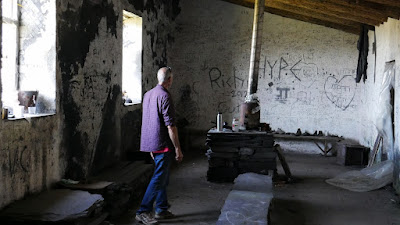
Arenig Fawr ruin

These are the beautiful words with which Solnit opens the first of four essays that punctuate the book, each entitled ‘The Blue of Distance’:

The world is blue at its edges and in its depths. This blue is the light that got lost. Light at the blue end of the spectrum does not travel the whole distance from the sun to us. It disperses among the molecules of the air, it scatters in water. Water is colourless, shallow water appears to be the colour of whatever lies underneath it, but deep water is full of this scattered light, the purer the water the deeper the blue. The sky is blue for the same reason, but the blue at the horizon, the blue of land that seems to be dissolving into the sky, is a deeper, dreamier, melancholy blue, the blue at the farthest reaches of the places where you see for miles, the blue of distance. This light that does not touch us, does not travel the whole distance, the light that gets lost, gives us the beauty of the world, so much of which is in the colour blue.


In these pieces, Solnit muses on how European painters of the 15th century began to paint the blue of distance, on walking the Great Salt Lake, and on the Spanish conquistador Cabeza de Vaca, who in 1527 ‘entered the realm of the utter unknown’, pursuing glory and gold.  Utterly lost in a strange land, after a decade of  wandering and hardship during which his self was ‘pared back to nothing, no language, no clothes, no weapons, no power’, he finally encountered a party of fellow Spaniards, but could see them only as thieves who ‘bestowed nothing on anyone’. For Solnit, de Vaca’s story is that of someone who ‘ceased to be lost not by returning but by turning into something else’, the rare exception that proves the truth of Eduardo Galeano’s observation that, in Solnit’s words,


 America was conquered, but not discovered, that the men who arrived with a religion to impose and dreams of gold never really knew where they were, and that this discovery is still taking place in our time.  This suggests that most European-Americans remained lost over the centuries, lost not in practical terms but in the more profound sense of apprehending where they truly were, of caring what the history of the place was and its nature.

 
Then there’s Yves Klein, an artist of grandiose ambitions and mystical tendencies who, influenced by Rosicrucian notions of pure realms of colour, painted canvases of an intense blue – his patented International Blue – the colour that represented for him the spirit, the sky, and water: the immaterial and the remote, distance and disembodiment.  In 1960, in The Leap Into the Void, he created a work of art that exists only in a photographic record, a gesture concerned with ‘erasing the map of reason and entering the void of pure consciousness’.
In this essay, Solnit connects Klein’s mystical explorations with fascinating observations on map-making, and the disappearance from modern maps of ‘Terra Incognita’, blank, unmapped terrain often imaginatively populated by cartographers with mythical beasts. (Like Solnit, I possess an atlas published at the beginning of the 1900s in which a few regions of the globe still appear white and uncharted.)


The autobiographical sections of the book are intense, intimate and written beautifully.  There is one that begins in an abandoned hospital, where paint peels from the walls and ceilings, flakes clinging to the walls ‘like papery bark and piled up like fallen leaves’.  The memory of this place leads Solnit into recollections of Marine, a friend who ‘plunged into the unknown again and again’, finally lost to the abandonment of drugs.  Another chapter begins, ‘Once I loved a man who was a lot like the desert, and before that I loved the desert’.  Arrowheads and rattlesnakes, a kangaroo mouse and cottontails populate the story of losing herself in a love that eventually shatters.  Yet:

    I came out … transformed, stronger and surer than I had been, and carrying with me more knowledge of myself, of men, of love, of deserts and wildernesses.

In the final essay a dream of a tortoise leads to a childhood memory of riding a tortoise in a zoo, which leads to an encounter with a tortoise in a desert, which leads to the environmental protection now afforded to American tortoises, and on and on, culminating in a shocking memory of Solnit’s father, stressed and frustrated by his efforts to save Marin County from developers, taking out his fury on his daughter.


I had read one previous book by Rebecca Solnit – Wanderlust: A History of Walking - which I wrote a bit about last month.  That book had a similar tendency to ramble off in all directions (not a failing in my book), but Lost transcends it.  I loved being lost in the labyrinth of its thoughts and memories; I have emerged enriched and knowing more.


Gerry Cordon:First published on'That's how the light gets in'

Wednesday, 5 June 2013

A Harry Griffin: A lifetime of mountains...a Eulogy


The following is the eulogy delivered by the Reverend Canon John Hodgkinson who conducted the funeral of Lakeland mountaineer and writer A Harry Griffin at Holy Trinity Parish Church, Kendal, Cumbria 30 July 2004.

HARRY FELL IN LOVE at 18 and everything that he did stems from this. "For better for worse, for richer for poorer, in sickness and in health, until death us do part." Some just fall in love, but Harry was infatuated. He often spoke of the magic of the mountains, and Harry was spellbound by them. All other loves had to take second place to the fells.

In his book Long Days in the Hills, Harry wrote: "This book is also, in its way, a love story. Why so many of us have such deep-seated affection for great areas of uplifted land, the largest monuments of nature, is difficult to explain. So many things are part of our mountain heritage - the speech of the dalesfolk, the old stone walls, the smell of the wood smoke on an autumn evening, the wild life, the music of the becks, the silence of the woods and the cheery welcome of a country inn."


First of all for Harry, it was the daredevil adventure of rock climbing, the steep learning curve, the numbing fear and then the exaltation of success, the partnership, the teamwork, like that of men in battle. Fell walking was a means to an end, but then, as he aged, an end in itself. Harry climbed in the Lake District, North Wales, Scotland, the Alps, the Canadian Rockies and in the foothills of the Himalaya. He skied in the Lake District, Scotland, the Alps, Canada and the USA.

Harry had to earn a living so that he could pursue his passion of getting into the fells at every opportunity. He became a trainee journalist at Barrow and then joined the Lancashire Evening Post in Preston. In 1937 he was on the staff of the Daily Mail in Manchester, and he was their northern music critic. Music was very important to Harry, and he was a good pianist. In addition to covering Hallé Orchestra concerts he did many in-depth interviews with world-famous musicians including Rachmaninov, Sir Thomas Beecham, Paul Robeson, Richard Tauber and Paderewski. When Rachmaninov was playing one of his own concertos, Harry wrote that he played the third movement too quickly!

In 1934, young Harry Griffin and attractive Mollie Barker went to Skye. On the second day a boatman took them through a choppy sea on a very uncomfortable journey and they were drenched when deposited at Loch Scavaig. The aim was to walk into the heart of the Cuillin, climb 3000ft through a pass, then down the other side to Glen Brittle. The map didn't seem to help: this was much wilder than the Lake District. They climbed 2000ft, but they had to come back. Another mile's search along the seashore and they tried again eventually reached the ridge, but it wasn't the pass. Some 20 times Harry had to lower Mollie by rope. It was getting dark and still raining. "We scrambled, slipped and squelched in the darkness, fell into burns, tore our already tattered clothes, grazed hands and knees, tripped headlong in the heather."

Then it was just another sodden exhausted three-mile hike until they were welcomed by a very worried Mrs MacRae. Harry certainly knew how to woo a girl. In spite of this, Mollie Barker married Harry on 23 October 1937, suspecting that she would take second place to the mountains. Mollie gave birth to son Robin, who was to became a qualified mountain leader. He completed the ascent, with his wife Mary, of all the 2000-foot mountains in England, and climbed to nearly 22,000 feet in the Himalayas. His sudden death aged only 58 was a tremendous blow to the family. Daughter Sandra is now retired with her husband Tony in Vancouver. Not surprisingly, she also grew up to love both the Lake District and writing.

Now, back to 1939. Harry joined the army as a volunteer. He was commissioned in the Cheshire Regiment and then transferred to the Royal Artillery. As we know, Harry was a man of superlatives, so when stationed at St Margaret's Bay Harry claimed that he was the nearest British officer to German-occupied France. Harry spent one year in Orkney helping to protect Scapa Flow, and then a period in London during the blitz. After intelligence training, he arrived in Imphal, Burma, during its siege, serving also at Mandalay and Rangoon. He once nearly fell out of an aeroplane when taking part in a supply drop to troops behind the Japanese lines. On another occasion he was blown up in an ammunition dump, suffering only very minor injury, but he was never in any danger from the enemy. Demobilised in the spring of 1946, Harry had risen from private to lieutenant-colonel at 34 years of age.


A young Harry Griffin (right) and George Basterfield at Wasdale

After the war, Harry rejoined the Lancashire Evening Post in Kendal to organise new northern editions, ultimately becoming northern editor. Did you know that Harry was the fastest journalist in the world, on water? He attended all the water-speed trials in England of Donald Campbell, and was the only journalist to have taken part with him in an actual trial, when the boat had twin cockpits. They attained a speed of something over 120mph. Harry secured a world scoop for the BBC on the occasion of Campbell's death, a big scoop at the Williams pit disaster at Whitehaven, and several others.

Harry couldn't have done half that he did without great backup from Mollie. They celebrated their golden wedding in 1987, and Mollie died a year later. Harry was desolate. He left his house with its superb view for an apartment in Kendal. I called to see him and he greeted me with "Welcome to Colditz." Two years later Harry asked me to officiate at his marriage at Holme Church. The Master of Ceremonies announced the entrance of the bride, "Violet Macaulay MBE, JP." Harry was aged 79, whilst I was two weeks into retirement, a mere 63. At the reception Harry was in great form. He said that he was sorry to bring this poor old vicar out of retirement to take the service. He added that he was transmogrified. I had to look this up when I returned home. "Transformed in a magical and surprising manner." Harry had written so often of the magic of the fells, and now the magic of this special day. "Magic" was a word that Harry used again and again

The spell was broken all too quickly. Violet died of a sudden heart attack some five months later. He wrote in his Guardian column: "Our last little walk together was five days before she passed away. It was a crisp, sunny afternoon with ice on the track and streaks of snow on the tops. She struggled on bravely up the rise, stopping now and again to look at the expanding view. At the last stop a robin alighted at our feet, suddenly appearing out of nowhere as robins do, and Violet talked to it. The robin, bright red, perky and friendly, accompanied us up the track.

"A week later, re-arranging her possessions and trying to decide which of three large flower pots to retain, her friend told me: 'She always liked that one - the one with the red robins on it. She loved robins.' So I kept that one and it now stands halfway up the stairs, full of her favourite flowers with the little red robin peeping out." Harry wasn't afraid of sentiment and rich colour, and this endeared him to his readers. Seven months later there was a new partner, Josie Barbara Clegg. She was a great carer and of course she spent a lot of time with Harry in the fells. That was essential.


After seven years, the death of Josie brought Harry close to despair. "She wouldn't let me do a thing." Knowing Harry, I don't think that he would have done a thing anyway, but what he meant was that Josie didn't mind. Harry told me that he was helpless, that he couldn't even boil an egg. I told him that he was idle, but he replied, "No. I am a writer."


Harry was indeed a writer, and a writer who was captivated by the mountains, with 14 hardback books about the Lake District to his name. He told me that he had written more books about the Lake District than any other writer, including Alfred Wainwright. The weekly feature article, "From a Lakeland Notebook" was published in the Evening Post for 46 years, and Harry has been contributing to his Lake District Country Diary in the Guardian for an unbroken 53 years. This is the longest continuous feature of any newspaper in the world.


And yes! Harry had worldwide fans. He brought pleasure to thousands, especially to those who were locked into city tenements or exiled in other lands. He described the sky, the wind in his face, the light and shade and rich palette of the fells. The readers were very grateful. Many wrote. All received a reply. But Harry had a short fuse and could even be irascible. Stephen Greenwood tells of how at Dow Crag, Coniston, there was hue and cry nearby. A man off. There were six able-bodied men available and with the help of a big heavy iron stretcher they took the injured man all the three difficult miles down to Coniston to the Black Bull. The man then sprang off the stretcher and said, "Now then, what will you all have to drink?" Harry's comments haven't been recorded, but I wouldn't be surprised if he had wrapped the stretcher round the man's neck!


Modest in writings but also proud of achievements, Harry's Guardian column was headed "A Harry Griffin". It should of course, said Harry, be "The Harry Griffin". He rejected the naming of a tarn after him, adding that anyway it was a pretty undistinguished and dreary pool.
An MBE was awarded in the New Year's Honours List 1996, "for services to literature and the Lake District", and there is the Griffin Bar at the Beech Hill Hotel, Windermere.


Alfred Wainwright gave us his splendid maps and pictures which opened up the Lake District, but Harry gave us its living heart, and he has become a legend in his own lifetime. Harry died in harness, beating his former Guardian colleague, Alistair Cooke, in this respect. His last article was published [on 12 July 2004] along with his obituary.

I visited Harry in hospital. He greeted me warmly and was then very still whilst I blessed him. I whispered "There are still many heights to conquer, Harry". He died the next morning.
I like to think that he became young again, and that when he saw the sheer beauty and infinite challenge of the heavenly mountains, he was ... transmogrified.


Illustration from 'A lifetime of Mountains'The Guardian-Editor Martin Wainwright


Reverend Canon John Hodgkinson. 2004


Friday, 31 May 2013

The mountaineers: lost in time.


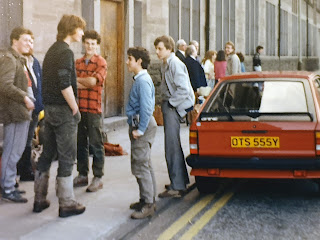
Can you identify these five climbing amigos? Even better,can you suggest a location and date? I'm indebted to Climbers Club archivist David Medcalf for allowing me to use this fantastic shot. David posted it yesterday on the members forum after being pointed towards it by a friend who saw it on an 'Old Photos of Portmadog' website. Apart from the predictable suggestions of a less than serious nature including Ron Fawcett, Eric Jones and Geoff Birtles!.. no one as yet has come up with any hard evidence suggesting exactly who these rakish rock masters are.

My own hunch is that the group are in the Ogwen Valley with Llyn Ogwen just beyond the wall and the slopes of Pen yr Ole Wen in the background. It looks a wet day but it certainly hasn't dampened their spirits. If you have any information or comments then email me at mynyddgoch@yahoo.com and I'll add them here.


One suggestion which has come in since posting, has come from Gordon Stainforth,the renowned author/photographer, who suggests that the figure on the extreme right could be George Abraham. Another renowned photographer, mountaineer and author of climbing guides in the early 20th century. This makes a lot of sense as Abraham was in North Wales-presuming this is North Wales- in the Edwardian era.Writing a climbing guide and joining up with the leading lights of the day including Archer Thomson. Geoffrey Winthrop Young on the extreme left is another suggestion?


Friday, 24 May 2013

The Beautiful and the dammed


The two north-easternmost spokes in the great Lakeland wheel, Swindale and Mardale, could hardly be more different. To their west, or anticlockwise, the great glen of Ullswater cleaves down from Pattererdale towards Penrith. The blue shape of the lake on the map marries so closely with curve of Haweswater, to its east that, if you half-close your eyes (and use enough imagination), you can see the pair of them as a whale calf nestling up to its mother.

Eastwards, or clockwise round the wheel, the boggy uplands of Mosedale send their waters down the Sleddale Beck by a channel whose banks are starry with primroses each April. That water flows into the Lowther and at last the Eden in its long bending north. Starting from the same watershed, on Hartsop Pike, the Crookdale and Borrow. Becks trend south-eastward to enter the Lune near Tebay and finish up 40 miles away in Morecambe Bay. As for the difference between Swindale and Mardale ... well, we can hardly use `Mardale' any more except historically.


From 1935 onwards, the sweet valley was drowned to make a reservoir. The original lake was doubled in length and trebled in surface area. The dam looms like a prison wall. So Manchester needed the water.  So Mardale village had to go – its houses, its farms (which used to send 3,000 lb of butter south by train each week), the houses, the pub, the school, the reading-room, the church – the lot. The stones of the church were recycled to make the intake well for the dam. One hundred and four dead from the graveyard were reinterred in 'the Mardale portion' of Shap graveyard. Mardale was written off by the pro-dam interests as 'an overrated beauty spot' and the home ground of only 100 people.


Mardale Valley-before the flood

Am I deceiving myself when I believe that it couldn't happen today? That people's awareness and their protests would deter the authorities from destroying a community? Nowadays, whenever there is a prolonged drought, you can be a ghoulish tourist and poke about among the bones of Mardale. When the water sinks low, walls are bared, an arched bridge, heaps of rubble with caves between them – the cellars of the pubs. I'm ashamed to say that when I found a piece of a stone ginger beer bottle here in the summer of 1983,1 brought it away with me. Next year, another drought, and cars queued the length of the dale to see the wreckage. An ice-cream van sold refreshments. Worse locusts than me began to steal the coping-stones off the bridge and after a few weeks the parapets were gone. Up on the hillside there is a rock-climb called Dun Bull – last evidence above water of the bygone pub which had hosted many an epic of feasting and drinking when stray sheep were gathered in at the Mardale Meet.


The link between Mardale and Swindale is the Old Corpse Road. It tracks east-north­eastward up the hill opposite the pine-covered peninsula called The Rigg, crosses the watershed, and at last drops down into Swindale at its head. The Mardale folk carried their dead this way to Shap until they got their own church early in the 18th century. Until then the long carry had caused `excessive expense for funerals, and the souls as well as the bodies of infants taken to be baptised are endangered'. I last walked that way with my wife and another poet, who spent some miles extolling the virtues of Hunza apricots and doling out a few from time to time. (They're supposed to help you live longer – I can't yet vouch for this from my own experience). For weekly worship the Swindale folk had to make do with a chapel at Truss Gap Farm. Am I imagining this or did Harry Griffin, the renowned walker and climber, once recall that he had found the organ in the disused chapel and that, being expert on the keyboard, he coaxed from it a few struggling notes?


Swindale has never been ample enough to sustain settlement on the Mardale scale. It has stayed as it always was, beef cattle browsing the water meadows, sheep on the hill, a narrow zone of lush hayfields (one of which was named in a 13th-century document). On the eastern flank Gouther Crag juts out above slopes deep in ferns and foxgloves and bunchy trees. The grassy quietude of it all is entrancing. One time, when I was on a stance high up on a route called The Fang, I saw a hay tedder working along a field of ripe hay down below on the river-bank and I was able to delight in the perfect matching of the silken stripes of mown grass on the yellow-white stubble with the meanders of the watercourse.


The Drasdo Brothers-Neville leading-Harold hiding in the trees:photo John Appleby

Fang Buttress on Gouther Crag was named after a downward-pointing finger of rock, like a big blunt grey icicle, at the start of a route called Sostenuto, which was put up in 1958 by the Drasdo brothers from Bradford. When I first climbed it with my stepson in 1983, the right ridge of the fang was a help as you struggled to get started. Two years later I was climbing with the Drummonds – Ed, pioneer of scarcely believable routes in North Wales and Yosemite, and his wife Leah, a beginner. Ed had never climbed in the Lakes before. His first sally was to amble upwards unroped beside Leah and myself on a straightforward route called Kennel Wall. He looked unstoppable, fearless, agile as a cat, with hands like a bear's paws. When we went to start up Sostenuto, I found that the fang had fallen off, whether by gravity or due to some earth tremor. I was intrigued to see that Ed, who had climbed routes of the greatest difficulty (Main Wall on Clogwyn dur Arddu, the North America Wall on El Capitan), had to try twice before he could start Sostenuto without the aid of the fang's clear-cut edges.


Ed Drummond..'fearless and agile as a cat with hands like bear's paws':photo John Appleby
 

At the top of Gouther Crag, 500ft above the floor of the dale, you step off into another zone – trackless moorland, where I had my only sight of red deer in Cumbria. Five or six animals fled swiftly along then melted into the heather and blaeberry as they cunningly found cover beyond a rise in the ground. The same lovely contrast between the ruggedness and salience of the dale sides and the gently undulating moorland up above holds good all round the compass. At the dale-head Hobgrumble Gill and Mosedale Beck flow together beside a knoll called The Knott to make the Swindale River. The Mosedale has just plunged several hundred feet in a series of white cascades called Swindle Forces.

On days after heavy rain they have made me exult in their headlong plunge and reminded me of Beethoven – that rush and onset and resolution of many clashing sounds. Then, 'suddenly', as you emerge onto the levels of the moor above, the water is quite small, a brown peaty flow between banks of tousled heather that has never beenburnt or used in any way. All is calm. The water flows from one black pool to another by stony runnels just too broad to jump, so that you have to cross it by balancing along the wires of a rusty fence. Silence surrounds you, accented by the occasional pipe of a meadow pipit or the bark of a raven. It's like the lulling hush of an Andante after the speed and tumult of the opening movement. (The Drasdos' other route on Gouther is called Sforzando).


Haweswater offers few such elementals these days. The walk along the north shore is pleasant enough. A mile or two along from the dam the path picks its way past a craggy burst of waterfalls which offer superb terrain for hide-and-seek or scrambling or picnics on coigns among the birches and rowans. Always beside you the mass of trapped water imposes its sullen presence – a lake, it's true, but one whose oddly uniform shores betray that it was man-made, forced onto nature. You can appreciate the difference from wild water if you come down into Haweswater from its south end by either of the two old packhorse routes, either from Nan Bield at the head of Kentmere or from Gatescarth beyond Longsleddale. Up there the two tarns in their corries Blea Water and Small Water, are cupped as beautifully as raindrops in the calyx of a flower. Like Scales Tarn below Sharp Edge on Saddleback, they have rounded or lobed shapes of an organ inside a body or a chestnut in its husk.


Haweswater opens out northward towards Bampton and Lowther – well tended farming country. Swindale opens out eastward past a strange neutral ground crisscrossed by a maze of aqueducts and covered channels that pipe Cumbrian water down to Preston and Manchester. There is a fundamental change below ground there – the joint between the slates and schists of the north Lakes and the limestone which comes scything up from Kirkby Stephen. Shap Abbey is a stranded relic of the medieval age when monks built a major wool industry on grasslands that flourished on lime-based soils. Now that affluence has gone – also the trade brought in to Shap by the main road north. Shap feels backwatered these days – its pubs and shops not quite thronged enough, though equally you can enjoy their decent calm. It still gladdens me to be there because, looking westward, we can see the perky profile of Kidsty Pike and know that the particular atmospheres of Swindale and Haweswater are waiting for us there.


David Craig. First Published in Cumbria
 

Friday, 17 May 2013

'Lord Baker' in Langstrath: Cam Crag Ridge


Siobhan Appleby above Langstrath.

There was a lord who lived in this land Being a lord of high degree.
He left his fort for a ship's board
And swore strange countries he would go see.


Langstrath sounds like what it is - a flat valley floor as wild and 'lang' as a border ballad - and I'd never set foot in it. I don't know how that had come to be the case. It's a bit of an embarrassment really in a mountaineer with a hairline well in recession. (Until last year I'd never walked up Ennerdale either.) If you're always going to crags you can miss out on some fine valleys even in Borrowdale. So wanting to be a lord of this land in some degree I 'swore strange countries I would go see'.


Resting my fully extended rucksack against a wall to check the map at the first bridge across the beck I found that the midges tend to take a bite at midday here in July. I was sweating already and knew that with camping and climbing gear, not to mention wine aboard I'd soon be slightly extended myself. Norman, Kevin and Barbie were already well ahead, but I find that sailing up the motorway from Sheffield can actually weaken your legs.

He travelled east and he travelled west
He travelled south and the north also
Until he arrived into Turkey's land
Where he was taken and bound in prison
Until his life it grew weary.


It was a bit early to grow weary since I'd only walked from Stonethwaite's cottages and through the campsite, a magical grove that used to be romantically known as 'Fairy Glen' in books with titles like Odd Corners in English Lakeland. It certainly is an odd corner nowadays, though perhaps with fewer fairies. Who knows? Crossing the bridge there was a last glimpse of Eagle Crag round the corner to the left stuck out of the fellside like the end of an upright piano. Music seemed to be in my head as I followed the others into the unfolding long journey that is Langstrath. Whole herds of rustled cattle could be hidden in the pastures of this strath, knives could be drawn here, Turkey's daughter ('as fair a lady as the eye did see') could rise from bathing in Blackmoss Pot to cut Lord Baker's prison bonds and lead him to a ship harboured in the narrow black zawn of Sergeant's Gully. It's that sort of a valley.

The track, keeping close below the little broken walls of Heron Crag, brings you up to a flat-topped tower called Gash Rock which all but blocks the path. Below it is the green pool known as Blackmoss Pot where Harry Griffin, in a memorable entry for The Guardian's 'Country Diary', recommended bathing where 'neither costume nor towel was needed', although he did admit that 'this becomes too popular in heatwaves for my sort of dips, being too close to a well used track'. Above the track at Gash Rock the black cleft of Sergeant's Gully rises up straight as a sword.

Bentley Beetham on the first ascent of Little Chamonix in 1946: Photo FRCC

In O. G. Jones' first pitch by pitch guide to the Lakes of 1897 the Abraham brothers contributed a grainy granite-textured photograph of the difficulties on the fourth pitch of this climb. A wild beard of woodrush, the eagle's favourite nest lining, overhung the chockstone. The steep left wall offered the solution. Jones wrote, 'From a short distance this appears to be a smooth vertical slab; even on close inspection the holds it offers appear to be of the most minute dimensions'. Bentley Beetham's guide of 1953 commented: 'A very difficult pitch but no longer incommoded by vegetation'. It looked to me a great winter classic that holds the snow well and long. It's only given one star in Winter Climbs in The Lake District but this valley promises more than can be described in stars, words or grades. It needs music; it needs pipes for carrying on the long rush of air it contains.


At last, after passing above several notable alternatives to Harry Griffin's Blackmoss Pot, which almost tempted us to rashness, we saw the tent of friends we'd come to camp with high up the fabled Strath. They'd left their tent on the big bend above all the deep pots and plunging forces at a point where the river braids into little rolling plaits of water. By the time we'd pitched our own tents they'd appeared from up the valley and we all saw, looking back down the dale a soaring hump of rock, unnoticed on the walk in. Cam Crag Ridge stands clear of the green fellside as a slightly stepped, rounded spine on the skyline. Barbie was into the discoveries of the new scrambling guide after a long experience of fell walking and trekking. She vowed she'd climb the white back of Cam Crag Ridge, and this is the valley where vows are strong:

They made a vow for seven years
And seven more for to keep it strong
Saying `If you don't wed with no other woman I'm sure I'll wed with no other man.


Roused by the force of this we grabbed slings, rope and torches just in case, before stalking off through the grass, boulders and bracken to keep an appointment with the horizon.
Now it's in the nature of scrambling that a description in a guide cannot be as well defined as for a rock climb: you're finding your own way through uncharted wild country. If you accept that, you can pass below the jumble of boulders that probably provide a very interesting start to the ridge, and see instead the raven's nest round the corner, perched on a block, trailing a long bit of binder twine down into space. At the first platform on the ridge we began to savour the rock we were vowed to climb. Andy found a way, Barbie followed searching for holds with a clarity of purpose the ballads are made of. I threw more words and tunes to the wind behind, whilst Dave, forgotten at the back, enjoyed a new experience. Kev drifted about between us, focusing and refocusing his black Cyclops' eye from Japan as if the oral tradition had never existed.


Liam Appleby under The Glaciated Slab

Years seemed to pass as the ridge steepened and reclined, steepened and reclined in front of us. A little wall always gave to an open scoop, a top edge would reveal solid jugs to an easing slab up to a grassy break which we'd cross to a wall to start again. One steep section was littered with loose flakes which required care but mostly the rock was clean and sharp or leaning and rough, without tricks or traps. The final wall weakens with a groove and crack beside a tree. This last problem sharpens the enjoyment of hold-searching before a final rush to the flattening top of the ridge.


Barbie was pleased with her achievement, quite rightly. While I was babbling words she nodded silently, her eyes screwed up in that deep, inner, staring smile of hers. It was a great spot above the length of Langstrath with route-finding problems solved behind us. I was pleased to be part of it, but I was really married to the rock routes I realised that day, much as I'd enjoyed this scramble too. That night in the tent, well after dark, when all the bottles lay empty on the turf outside (temporarily) I sang what I could remember of the ballad of 'Lord Baker', how Turkey's daughter had searched for him when those seven years and seven more were over and done, finding him at last on the very day he'd taken a new bride in. When she sent a message that she was at the door asking for a piece of his wedding cake 'and a glass of your wine it being ere so strong',


He took his sword all by the handle,
Cut the wedding cake in pieces three
Saying 'there's a piece for Turkey's daughter, Here's a piece for the new bride and one for me'. And Lord Baker ran to his darling,
Of twenty one steps he made but three.
He caught his arms round Turkey's daughter

And kissed his true love most tenderly.

The next day Norman and I walked down the valley, Bowfell being in mist, hitched to the Bowder Stone car park and rediscovered the delights of pure rock moves which had been our true marriage all along; in this case the surprisingly neglected moves provided by Quayfoot Buttress, directly above the car park. Aberration (MVS), appropriately named for us, deserves to be better known since it rivals Ardus (Severe) on Shepherd's Crag for its delicate leftwards traverse on the top pitch. All that remained was a lunchtime pint in the Scafell Hotel with a warm lad who gave us a lift, a celebratory exchange of good routes yet to be done, and we'd both seen strange countries and found our true passion in the way of the narrative of things lived and sung.

Painting: Bill Peascod  


Terry Gifford: The Joy of Climbing: Whittles Publishing
Images: john Appleby unless stated.

Friday, 10 May 2013

Rhapsody in Rust


I found this old unpublished homage to V Dubs recently. I'm not even sure what media it was originally intended for but the sentiments expressed may still ring true for afficienados of original VW Campers and stir the same emotions.We're talking about the old air cooled rustbuckets here, which you could pick up for for relatively little and restore without breaking the bank.The modern VW Camper/Transporter is a totally different beast.With both water cooled petrol and diesel engines and costing a small fortune,the age of the '125 sheets' camper is well and truly in the past.


I took out all the seats and away I went
It's a right old banger and the chassis' bent .

It's got a great big peace sign across the back
And most of the windows have been painted black.
The windshield's cracked, it's a bugger to drive
It starts making smoke over thirty-five.

It's a psychedelic nightmare with a million leaks
It's home sweet home to some sweet arse freaks


Ian Dury


One of these days some young kid is going to write in and say; 'I've just passed my driving test and I'd like to know what's a good climbers car ?  Oh dear boy,do you really need to ask! For more than three decades there has really been only been one vehicle to chuck a sack in the back of and take off into them tha hills; a vehicle which has transcended mere transportation to become an icon of cool.The ubiquitous VW camper van. It doesn't matter whether your preference is for a 'splitty' , 'a bay' or a 'wedgie; the V Dub has become the vehicle of choice for climbers, surf bums and all cool creatures west of Bohemia.


My own attachment to VDubs goes back some years and remains worryingly undiminished. At the moment two red and white two-tone wagons sit outside;one a 69 bay, I'm thinking of exhibiting for the next Turner prize. This scrapyard thing, now all but stripped of its vital organs,has become a rusting, fading box of rare beauty.


Time and the elements have conspired to coat the bodywork with a scumbled patina while rust inexorably eats away at the extremities.Under the propped hood,in the empty engine compartment, an old sheep dog sleeps in the shade while up above, cats stretch out in the sun on the dented roof.

It came from a semi on Costa Geriatrica-Colwyn Bay-where I'd noticed it on my travels. Handing over 125 sheets,it was loaded on the back of a trailer I'd borrowed from a garage in Gweddelwern-the garage is no longer there; it literally blew up when it's cache of butane bottles went up like a nuclear device. The towing vehicle was a friend's Espace which saw it's clutch burned out tackling the 1-4 hills near home on the way back.


My current VW is a Wedgie which came from a windsurfing fiend a year ago.400 nicker sans MOT .I rather like the reflective rear window with the huge 'animal' logo and of course,the obligatory yin-yang sticker.


My home page shows a white wedgie marooned amongst a sea of Moroccan sand dunes under an indigo sky. It's a reflection of a dream I have.Driving down through France and Spain and then across to Morocco,down the coast to Mogodor where Hendrix and Joe Orton used to hang out in the sixties. Despite the fact that 'animal' hasn't been further than Aberdovey yet, who knows,it could happen? But then again, pigs might fly !

Anyone who drives an old camper has to expect to spend some time at the side of the road with the rear hood up. They have a habit of throwing the third cylinder and the Heath Robinson gear linkage often fails. I always carry wire and springs to effect running repairs. On a recent trip to Cornwall, I counted three old campers at various points broken down en-route. On a trip to the north west of Scotland,my starter motor went at Carlisle. The rest of the trip I had to effect the bump start which meant finding an incline I could park up on. On the way back, driving flat out on the Inverness by-pass, the rear nearside wheel bearing shattered causing the wheel to collapse and jam under the wheel arch.We careered across three lanes of fast moving traffic before coming to a stop. After applying some emergency treatment in the fortuitously sited lay-by we limped home to north Wales in 13 hours.My late friend Chas, drove back from Scotland to Wales with a totally knackered gearbox.Only able to engage 3rd, he kept an old flat iron propped up against the gearstick to stop it jumping out. Unable to do above 30, his journey home must have been even slower than ours.At least our crocked Combi could reach 40.


Then there was the time when my young friend Scott and I were on a climbing trip in the Lakes. We were parked up on one of the picnic sites next to Lake Coniston. Two o clock in the morning and with the smell of burning rubber and screeching tyres a trio of Cumbrian scallies circled our bus in their bangers, acting out a lakelandesque version of Fort Apache. My reaction was to run around in my underpants wielding a table leg shouting 'we've got a dog you know ! In hindsight,it sounds like a scene cut from Withnail and I.'


Did we have a dog...can't remember? If we did it must have been Tom, the first Labrador to climb a variant of 'Cyfwy Arete'. Scott slept through the whole thing. 


This addiction is becoming too much I've got three V Dubs which I've clocked on my travels, all sitting forlornly in someones drive. It's always the same " I'm sorry to bother you but I couldn't help but notice'.Then I'm driving home in a vehicle which bears more red oxide than original paint. It's not as if I haven't got enough to do. There's more to life than lying under a camper wearing a welding mask while sparks pour down like silver . One of these liberated machines was a blue bay which I only had for three weeks before a chance conversation down at the local tip saw a young hipster offer me a 300% mark up on the purchase price. Next time I saw him he told me 'well.. it was rotten as a pear underneath but I welded up and drove it to Frankfurt last week'. ( The Red Wedge was sold to a guy who drove it to Barcelona three days later).


The V Dub cognoscenti are invariably drawn from that category of humanity labelled 'likeable eccentrics'. One of these gentle souls was Mal, under whose tutelage I first took an engine out of a bus. Mal was a surprisingly sanguine character in the circumstances. Knowing that his toddler son had but a few months to live, he took off with him in his old bus on a caravanserai across southern Europe. 'We just wanted to give him a nice time before he died' he said in a remarkably calm, philosophical way. As we pulled the engine clear he remarked " well....do you think you could manage it by the side of the road in the Dordogne?'
Hmmm...possibly, but,at the side of the road on the Kendal by-pass in the pouring rain...Possibly not.

Camper's are made for summer. In winter they gather green moss and blisters. The heaters are crook and the thought of heading north swaddled in warm clothes trying to de-ice a frozen windscreen with a gloved hand is too much.

But then spring comes; you turn the key and the throaty aircooled engine spins into life. Levellers on the scrap-yard stereo, the musty smell of winter clinging to the sleeping bags, red wine stains on the rammy curtains and a curiously sticky steering wheel? Leaving the narrow lanes of Wales behind,cresting Aston hill at Ewloe; the Cheshire Plain stretches out as far as the eye can see. Beeston Castle, Stanlow Oil Refinery, the ICI plant at Runcorn. Familiar North west landmarks hove into view.Within half an hour I will be leaving the 56 and joining the M6. Pedal to the metal and she growls up to an impressive juice slurping 65. Sheesh! Behind me the hills of home...in front of me ... the north.


Words and images: John Appleby